The IPO Process: Step by Step
A US IPO runs through eighteen identifiable steps, from the organisational meeting that formally starts the process to the lock-up expiration roughly six months after listing. The sequence is standardised because it is shaped by the Securities Act, exchange rules and FINRA underwriting rules. What varies between deals is timing, not order.
This is the detailed walkthrough. For the short version see how an IPO works.
Before the process: readiness
Nothing below can start until the company can produce audited financial statements to public-company standards, close its books on a public-company calendar, and stand up the governance and controls that exchange listing requires. This work commonly takes a year or more and is invisible from outside. See IPO readiness.
Step 1 — The bake-off
Investment banks pitch for the mandate, each presenting its valuation view, comparable-company framing, marketing plan and distribution reach. The company appoints bookrunners — the lead-left bookrunner runs the process and appears leftmost on the prospectus cover — and co-managers.
Step 2 — The organisational meeting
The formal kickoff. Company management, underwriters, issuer's counsel, underwriters' counsel and auditors agree the timetable, the diligence plan and drafting responsibilities. Execution timelines are conventionally measured from this point.
Step 3 — Due diligence
Business, legal and financial diligence proceed in parallel. Section 11 of the Securities Act imposes liability for material misstatements in the registration statement, with a due-diligence defence that has to be earned — which is why underwriter diligence is adversarial rather than ceremonial. See Section 11 liability.
Step 4 — Audit and financial statements
Financial statements must comply with Regulation S-X as to which periods are presented and how they are audited. Emerging growth companies may present two years of audited statements rather than three. See emerging growth company.
Step 5 — Drafting the registration statement
The S-1, or F-1, is drafted across multiple all-hands sessions. Its principal sections:
| Section | Contains |
|---|---|
| Prospectus summary | The business and the offering in brief |
| Risk factors | Everything that could go wrong, in ranked order |
| Use of proceeds | What the company will do with the money |
| Capitalisation | The balance sheet before and after |
| Dilution | What new investors pay versus book value per share |
| MD&A | Management's explanation of the financial results |
| Business | The full description |
| Management and compensation | Officers, directors, pay |
| Principal and selling stockholders | Who owns what, and who is selling |
| Description of capital stock | Share classes, voting, preferences |
| Underwriting | Syndicate, fees, over-allotment, lock-ups |
See what is an S-1?.
Step 6 — Confidential submission or public filing
Most issuers submit a draft registration statement non-publicly first, which allows SEC review to begin without disclosing financials to competitors and without a public record if the company changes course. The drafts are published later, when the company files publicly.
Step 7 — SEC review and comment letters
SEC staff review for compliance with disclosure requirements; they do not evaluate the investment. Comments arrive in writing, the company responds in writing, and both sets of correspondence eventually become public on EDGAR — a genuinely useful and underused source of insight into where a company's disclosure was pressed.
Step 8 — Amendments
Responses are reflected in amended filings on Form S-1/A. Several rounds are routine. The price range and share count typically appear for the first time in an amendment shortly before marketing begins.
Step 9 — Testing the waters
Emerging growth companies may meet qualified institutional buyers and institutional accredited investors before or during registration to gauge interest. A JOBS Act accommodation, now available more broadly. See testing the waters.
Step 10 — Public filing and launch
The company files publicly and marketing begins. The preliminary prospectus — the red herring — circulates with an indicative range.
Step 11 — The roadshow
Roughly one to two weeks of institutional meetings, one-on-ones and group presentations, supported by a recorded management presentation.
Step 12 — Bookbuilding
Bookrunners collect indications of interest, tracking size, limit price and investor quality. The book is assembled continuously and is the basis for both pricing and allocation.
Step 13 — Price range revision
If the book is strongly covered the range moves up and the deal may be upsized; both require an amended filing. If it is not, the range comes down or the deal shrinks. Range revision is the clearest public signal of how a live deal is going. See IPO bookbuilding.
Step 14 — Pricing night
After the market closes on the evening before trading, the company and bookrunners set the final offer price and share count, the SEC declares the registration statement effective, and the underwriting agreement is signed.
Pricing is a negotiation. Underwriters generally advocate leaving something for the aftermarket; the company wants the highest defensible price. That gap is the underpricing debate in miniature. See why do IPOs pop?.
Step 15 — The final prospectus (424B4)
The final prospectus is filed, typically on Form 424B4. Its cover carries the numbers that were estimates until now: final price, final share count, the underwriting discount, proceeds to the issuer and to any selling stockholders, the over-allotment option and the ticker.
Comparing the last S-1/A with the 424B4 is the fastest way to see what the market did to a deal. See S-1 vs. 424B4.
Step 16 — Allocation
Underwriters allocate the shares, at their discretion. Considerations include expected holding behaviour, the price-sensitivity of each order, existing relationships, any cornerstone commitments disclosed in the prospectus, and any directed share programme set aside for employees or customers. FINRA rules restrict allocations to certain industry-affiliated "restricted persons." See IPO allocation.
Step 17 — Listing and the opening auction
Exchange Act registration of the share class is effected on Form 8-A, and trading begins. The first trade comes from an opening auction, not from the offer price:
- NYSE. A Designated Market Maker publishes price indications as orders accumulate, consults the underwriter, and opens the stock when the imbalance can be cleared — often materially after 9:30 a.m.
- Nasdaq. The IPO cross runs through a display-only period during which orders are entered and indicative prices disseminated, with the stabilisation agent confirming readiness before launch.
See the IPO opening auction.
Step 18 — Settlement, stabilization and the over-allotment
The offering closes and settles in the days after pricing. Meanwhile:
- Stabilization is permitted under Regulation M, which governs what underwriters may and may not do to support the price.
- The over-allotment (greenshoe) option — commonly up to 15% of the base offering, a limit set by FINRA Rule 5110, typically exercisable for 30 days per the prospectus terms — lets underwriters cover the short position they created by over-allotting. If the stock trades up they exercise and the company sells more shares. If it trades down they buy in the open market instead, which supports the price.
See greenshoe option and IPO stabilization.
After the process
Research coverage. FINRA Rule 2241 sets a minimum 10-day post-IPO quiet period for members that participated as underwriter or dealer. Emerging growth companies are exempt, so most modern US IPOs see syndicate research immediately.
Lock-up expiration. Customarily around 180 days from the prospectus date, with staggered tranches and price-based early-release triggers increasingly common. See the IPO lock-up period.
First earnings. The first 10-Q as a public company.
Index eligibility. Inclusion in major indices follows its own seasoning and eligibility rules and can be a significant source of demand. See index inclusion after an IPO.
The filing sequence on EDGAR
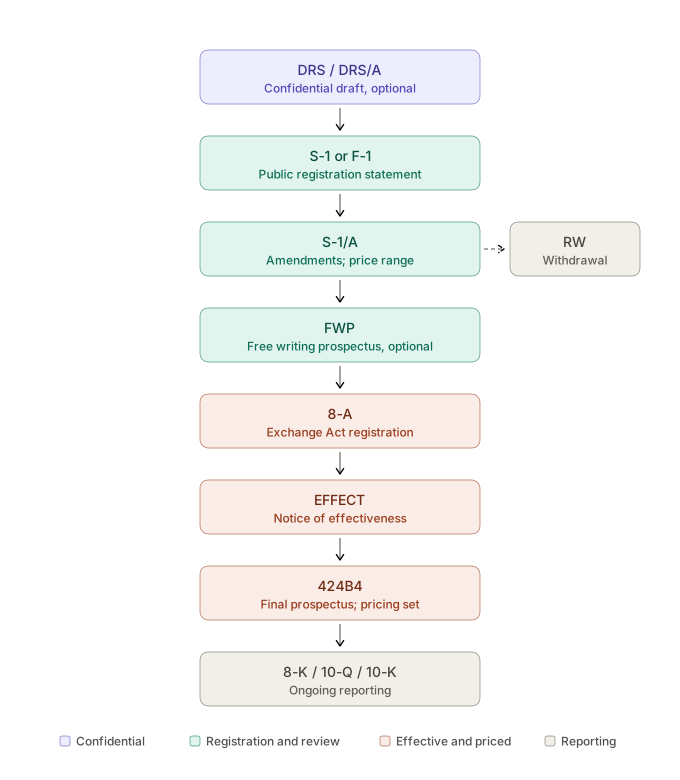
In order: DRS → S-1 or F-1 → S-1/A → FWP → 8-A → EFFECT → 424B4 → 8-K, 10-Q, 10-K. A withdrawal is filed on RW.
A withdrawal, if it happens, is filed on RW. See the IPO filing lifecycle.
How many rounds of SEC comments are normal?
Several. The count varies with the complexity of the business and the quality of the initial filing. Novel revenue recognition, unusual corporate structures, non-GAAP measures and regulated-industry models all generate more.
Do all IPOs use a greenshoe?
Not all, but it is standard in firm-commitment offerings. The prospectus underwriting section states whether one exists and how large it is.
Related
How does an IPO work? · How long does an IPO take? · How much does an IPO cost? · What is an S-1? · S-1 vs. 424B4 · Glossary
Sources
- SEC — Securities Act registration and review process; Regulation S-K; Regulation S-X
- NYSE IPO Guide and NYSE auction materials
- Nasdaq IPO process and listing materials
- FINRA Rule 5110; FINRA Rule 2241
- Regulation M
- JOBS Act of 2012
- Issuer filings on EDGAR