The IPO Filing Lifecycle
A US IPO leaves a public paper trail on EDGAR from months before the company is willing to talk about it until long after it lists. Learning the sequence lets you follow a deal in real time — and, more usefully, tells you what stage a company has actually reached when a headline says it is "planning to go public."
The sequence
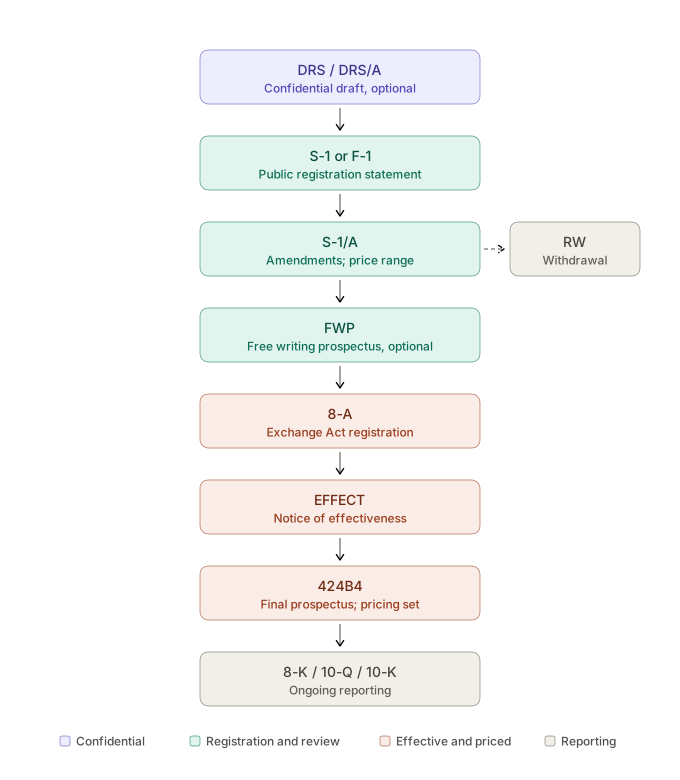
| Form | Stage | What it signals |
|---|---|---|
| DRS / DRS/A | Confidential | The company has started SEC review privately |
| S-1 / F-1 | Public registration | The company is committing publicly |
| S-1/A | Amendments | Review is progressing; the price range appears here |
| FWP | Marketing | Supplementary offering materials, where used |
| 8-A | Listing | Registering the share class under the Exchange Act |
| EFFECT | Effectiveness | The SEC has declared the registration statement effective |
| 424B4 | Priced | Final terms; the deal is done |
| 8-K / 10-Q / 10-K | Public company | Ongoing reporting |
| RW | Withdrawal | The offering has been abandoned |
DRS: the confidential start
The first thing most IPO candidates file isn't public when they file it. A draft registration statement goes to the SEC non-publicly, starting the review process without disclosing financials to competitors.
This began as a JOBS Act accommodation for emerging growth companies in 2012 and was later extended more broadly. It has become the default: a company that files publicly with no prior confidential submission is now the exception.
What this means for reading the news. When a company "files for an IPO," it has usually been in SEC review for months already. The public filing is not the beginning of the process; it is the company deciding to be seen doing it. Conversely, a company that submits confidentially and abandons the process leaves no contemporaneous public trace.
The drafts are published later, when the company files publicly — so you can eventually read the whole sequence, including whatever changed between the first draft and the version the world saw.
See Confidential IPO filings.
S-1 or F-1: the public filing
The registration statement becomes public. For domestic issuers it's an S-1; foreign private issuers file an F-1.
At this stage there is usually no price and no final share count. What the first public filing gives you is the business, the audited financials, the risk factors, the ownership structure, and an indication of how much the company hopes to raise.
See What is an S-1?.
S-1/A: where the deal actually takes shape
Amendments respond to SEC comments and update the terms. Several rounds are normal, and this is the most informative part of the sequence to follow live.
The price range appears here, typically in an amendment shortly before marketing begins. So does the final-ish share count.
Revisions to the range are the signal to watch. Moved up, and the book is covered comfortably. Moved down, and it isn't. This is public, timestamped, and available before the stock trades.
The SEC's comment letters and the company's responses also become public on EDGAR after the fact, which lets you see retrospectively which disclosures were contested.
FWP: supplementary marketing material
A free writing prospectus is written offering material used alongside the statutory prospectus and filed with the SEC. Not every deal uses one. Where they appear, they're often the recorded roadshow presentation or supplementary materials for particular investor groups.
Worth noting: FWPs aren't strictly sequential. They can be used at various points during the offering period rather than at one fixed stage.
8-A: registering to list
Form 8-A registers the class of securities under the Securities Exchange Act of 1934, which is a separate requirement from registering the offering under the Securities Act of 1933. It's the filing that makes the shares eligible to be listed and traded.
It typically lands around the same time as effectiveness, and the ordering between the two isn't fixed across deals.
EFFECT: the SEC signs off on the disclosure
The EDGAR notice recording that the registration statement has been declared effective. This is the point at which securities may lawfully be sold.
It is emphatically not an endorsement. The SEC has reviewed the disclosure for compliance, not the investment for merit — a distinction every prospectus cover states explicitly.
Registration statements don't go effective on a fixed countdown. Issuers customarily include a delaying amendment and then request effectiveness when the deal is ready to price, so the timing reflects when the company wants to go rather than an automatic clock.
See The SEC does not approve IPOs.
424B4: the final prospectus
Filed after pricing, within two business days under Rule 424(b) and in practice almost immediately. The first document in the sequence with real numbers: the actual offer price, the actual share count, the actual underwriting discount, the actual proceeds split between the company and selling stockholders.
Comparing the 424B4 with the last S-1/A is the fastest way to see what the market did to the deal.
See What is Form 424B4? · S-1 vs. 424B4.
After listing: 8-K, 10-Q, 10-K
The company enters the Exchange Act reporting cycle:
- 8-K for material events, filed as they occur
- 10-Q quarterly
- 10-K annually
- DEF 14A proxy statement ahead of the annual meeting
- Forms 3, 4, and 5 when insiders acquire or dispose of shares
Foreign private issuers report on 20-F and 6-K instead.
Insider Form 4 filings become particularly interesting around lock-up expiration, because that's when restricted holders first become able to sell. See IPO lock-up period.
RW: the branch nobody plans for
If a company abandons the offering, it withdraws the registration statement by filing Form RW. This is public, and it is one of the least-watched signals in the market.
Withdrawals can happen at any point before pricing. They cluster around volatility rather than company-specific problems, though both occur, and a withdrawal is frequently followed by a refiling months or years later rather than a permanent retreat.
See Withdrawn and postponed IPOs.
How to follow a deal in real time
- Set an alert on new S-1 and F-1 filings in sectors you care about. This catches companies at the moment they go public with their intent.
- Watch for the amendment that adds a price range. That's the signal the deal is close to launching.
- Compare each subsequent amendment's range against the last. Revisions are the clearest available read on demand.
- Check the 424B4 against the final amendment. Price versus range, final size versus indicated size, gross spread.
- Diary the lock-up expiration from the underwriting section.
Quick answers
What's the first SEC filing in an IPO? Usually a confidential draft registration statement (DRS), not the public S-1.
How long between the S-1 and listing? Commonly one to three months from the first public filing, though much of the review typically happened earlier under confidential submission. See How long does an IPO take?.
Where does the price range first appear? In an S-1/A amendment, not the original filing.
What does EFFECT mean? The SEC has declared the registration statement effective, so shares may lawfully be sold.
Is 8-A the listing application? No. It registers the class under the Exchange Act. The exchange runs its own separate listing application process.
What happens if a company pulls its IPO? It files Form RW. The prior filings stay on EDGAR permanently.
Are all these filings free to read? Yes. EDGAR is public and requires no account.
Related
What is an S-1? · What is Form 424B4? · S-1 vs. 424B4 · Confidential IPO filings · Withdrawn and postponed IPOs · The IPO process: step by step
Sources
- Securities Act of 1933 and Securities Exchange Act of 1934
- Securities Act Rules 424 and 430A; Rule 477 (withdrawal)
- SEC EDGAR — form types and filing requirements
- JOBS Act of 2012 — confidential submission
- Issuer filings on EDGAR